
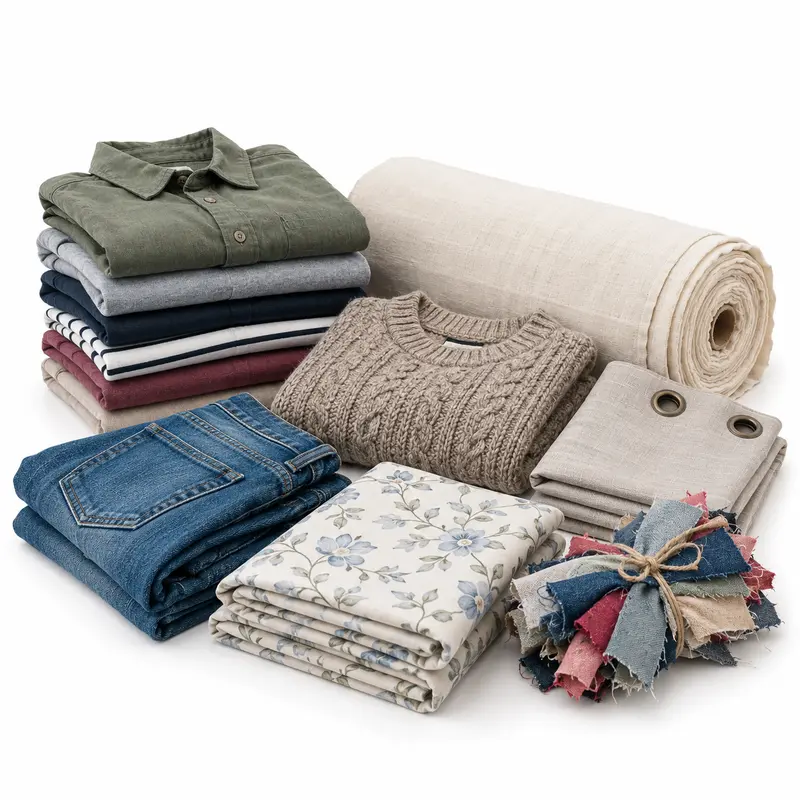
Textile and Clothes Scrap Request Guide for Peer Muchalla, Zirakpur
For clothes and textiles in Peer Muchalla, keep usable garments, household fabrics and recovery material identifiable by owner. A shared project reference or collection notice cannot establish a charity recipient, paid buyer or downstream reuse outcome. Textile requests should distinguish wearable clothing, reusable household textiles and fabric-recovery material. Labels can describe known fibre content, but an unmarked mixed bag remains uncertain. Payment, donation, reuse and recycling are different outcomes requiring an actual recipient or buyer's confirmation.
Use the wider material guide for classification questions and the address guide for the actual premises. The selected buyer confirms the offer for the inspected lot. Textiles and Clothes material guidance, Address and handover guide, and Offer factors to review. Acceptance depends on the material type, condition, quantity, collection address and selected buyer.
Textiles and Clothes Details to Share
| Request detail | Details to share |
|---|---|
| Textile form | Describe clothing, offcuts, household fabric, wool or commercial material. |
| Reuse condition | Separate wearable or reusable items from torn or recovery-only pieces. |
| Fibre information | Share known labels or specifications and state mixed/unknown where necessary. |
| Cleanliness | Disclose moisture, stains, contamination or treatment where known. |
| Attachments | Identify padding, hardware, coatings or other mixed components. |
| Ownership and quantity | Confirm release authority and give estimated count or weight by group. |
| Local lot and ownership | Describe wearable clothes, damaged garments, curtains, bedsheets or offcuts by actual condition and label evidence. Keep fibre uncertainty, stains, moisture, linings and mixed contents visible. Several owners should authorise their own contributions rather than one unqualified development-wide bag total. Mattresses and upholstery belong in separate appropriate item enquiries, not silently inside ordinary textile recovery. |
| Premises-specific handover | Identify the exact units holding the bags and ask whether a protected shared point is presently permitted. Confirm the actual recipient's or buyer's sorting and packaging requirements before pooling garments. Do not assume one project's entrance policy applies to another or that a central pin settles carrying from different floors. Label groups so owner and condition information remain available at inspection. |
| Measurement and release agreement | Agree whether the proposal is donation, per-item reuse or accepted-weight material recovery, and identify the actual consenting recipient or buyer. Clarify exclusions, quantities, collection charges and per-owner payment or donation allocation. A reusable item label or project name does not guarantee a sale or reuse. If no suitable route is confirmed, the locality guide does not promise a community outlet. |
How to Prepare Your Textile and Clothes Scrap Request
-
Identify the inventory
Record the disclosed textile and clothes scrap, textile form, reuse condition, the quantity unit and release authority. Keep retained goods and separately owned items outside this lot.
-
Locate the stored lot
For Peer Muchalla, Zirakpur, confirm the premises, unit, entrance and storage position. Describe the owner-confirmed entrance and any unit-specific carrying route. Publisher amenities or a road pin cannot establish today’s visitor permission, working lift or goods access.
-
Compare the same scope
Use the BharatBin app to review participating options for this disclosed request. Give garment, bag or bundle estimates with the actual basis. Count, volume and accepted textile weight are different measurements; ask what the participating option uses. Confirm acceptance, timing, carrying or specialist work and charges. Availability is request-dependent.
-
Confirm the inspected outcome
Reconcile the accepted inventory, recorded measurement, agreed rate or item offer, exclusions and charges. Confirm the final payable amount, payment timing and authorised payment recipient before handover.
Pickup-address information
Use Peer Muchalla as in the premises address, with Zirakpur, the society or street, unit and authorised entrance. Include Peer Muchhala or another variant only when it helps match the actual address. A Panchkula approach reference does not replace the city containing the lot. Motiaz Blue Ridge uses Peer Muchalla, Motia HUYS uses Peer Muchalla Road, and Imperial’s project history identifies Imperial Residency at Peer Muchalla. Imperial Apartments is separately described in Kishanpura adjoining Dhakoli. Preserve these project identities when locating the collection premises. For the disclosed textile and clothes scrap lot, the Peer Muchalla address decision is: keep project identity and city consistent through the request. Describe the owner-confirmed entrance and any unit-specific carrying route. Publisher amenities or a road pin cannot establish today’s visitor permission, working lift or goods access. Record textile form, reuse condition for the material at that storage point, then confirm the evaluation basis for that same lot. Confirm that garments and textiles are approved for sale rather than retained possessions, donations or goods belonging to another tenant. Keep the intended reuse or material-recovery request explicit when comparing offers. For a Peer Muchalla unit, disclose the full project or street address and the actual storage floor before asking about an offer. If the inventory includes furniture, electronics and fixtures, keep their owners and evaluation bases distinct. A nearby Panchkula landmark or another Imperial project does not determine who can release this lot.
Material and handling information
Keep dry recognisable groups separate where practical and photograph the general lot without revealing personal information. Do not include contaminated or clinical waste in an ordinary textile request. Identify whether items are household-owned, business stock or industrial offcuts, and confirm the seller has authority to release them. Collection, payment, donation and reuse are separate questions. Do not promise any of them for every garment or textile lot. Mattresses and upholstered furniture should use a more appropriate item guide and explicit acceptance rather than being silently included as ordinary fabric.
What to Confirm With the Selected Buyer
Compare acceptance, inspection, quantity measurement, handling responsibilities and the final payable amount for the actual disclosed lot.
| Comparison point | What to check |
|---|---|
| Same disclosed material | Compare the same inventory, included parts, condition and photographs. A separated lot and an unexplained mixed lot are not equivalent. |
| Evaluation and measurement basis | Ask whether assessment is by accepted weight, per reusable item or another disclosed basis. Explain how quantity was estimated and which groups are included. Confirm sorting requirements, excluded material and any collection charge before expecting a final payable offer. |
| Acceptance and minimum quantity | Confirm whether the buyer accepts the actual material and estimated quantity at the actual address. A category listing is not a universal acceptance rule. |
| Access and removal responsibility | Agree on the authorised entrance, storage-to-handover path, competent removal where needed and who provides labour or equipment. |
| Charges and exclusions | Ask about pickup, carrying, dismantling or handling charges and identify excluded material before agreeing to collect. |
| Final amount and payment | Confirm accepted quantity, final offer, deductions, payment method and timing after inspection and agreed measurement. |
Review participating options for the disclosed textile and clothes scrap and Peer Muchalla, Zirakpur address in the BharatBin app. Confirm acceptance, inspection and the final offer basis with the selected buyer. Availability varies by buyer and location.
Illustrative Request Example
Illustrative Textile and Clothes Scrap Request in Peer Muchalla, Zirakpur
Not a pickup recordA hypothetical planning example, not a pickup record, customer account, observed society inventory or proof of buyer availability.
- Example locality
- Peer Muchalla, Zirakpur
- Example material
- Example: If your request concerns a Peer Muchalla unit whose approach uses a Panchkula landmark, describe the offered textile and clothes scrap separately from anything retained or owned by someone else. The material question is textile form, reuse condition; the address question is keep project identity and city consistent through the request. Reusable clothes, fabric offcuts, household textiles and mixed worn fabric are different requests. Disclose known fibre labels, condition, moisture and mixing without promising a grade, resale route or universal acceptance. Describe the owner-confirmed entrance and any unit-specific carrying route. Publisher amenities or a road pin cannot establish today’s visitor permission, working lift or goods access. Compare the same included items at that stated storage position, rather than an offer for a different lot or an entrance that has not been agreed.
- Quantity details
- Example measurement questions: Ask whether assessment is by accepted weight, per reusable item or another disclosed basis. Explain how quantity was estimated and which groups are included. Confirm sorting requirements, excluded material and any collection charge before expecting a final payable offer.
- Property access
- Example premises questions: Describe the owner-confirmed entrance and any unit-specific carrying route. Publisher amenities or a road pin cannot establish today’s visitor permission, working lift or goods access.
A participating buyer still needs to confirm acceptance, inspection, collection availability, carrying or specialist responsibilities, any charges and the final offer for the actual request.
No fixed weight, price, buyer count, slot, fee or property-entry rule is invented.