
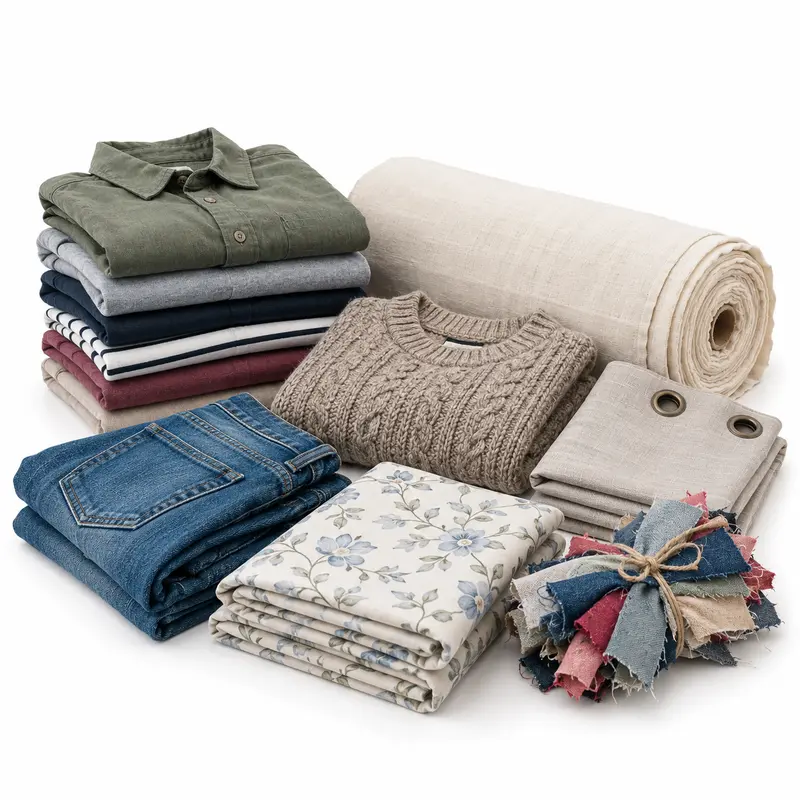
Textiles and Clothes Guide for Model Town, Kharar
This textiles and clothes guide for Model Town, Kharar covers the disclosed item or material lot: Describe clothing, offcuts, household fabric, wool or commercial material. Textile requests may include reusable clothes, cotton or denim offcuts, wool, household fabrics, curtains, bedsheets or commercial mixed material. Describe usable condition separately from damaged or material-recovery lots. A bag of textiles is not automatically one payable scrap grade or a guaranteed donation route.
Choose an available material guide for classification and the locality hub for address, ownership and handover planning. Model Town address and handover guide, Furniture, Paper Scrap, Plastic Scrap, Textiles and Clothes, General category guide, and Offer-factor guide. Acceptance depends on the material type, condition, quantity, collection address and selected buyer.
Textiles and Clothes Details to Record
| Request detail | Details to share |
|---|---|
| Textile form | Describe clothing, offcuts, household fabric, wool or commercial material. |
| Reuse condition | Separate wearable or reusable items from torn or recovery-only pieces. |
| Fibre information | Share known labels or specifications and state mixed/unknown where necessary. |
| Cleanliness | Disclose moisture, stains, contamination or treatment where known. |
| Attachments | Identify padding, hardware, coatings or other mixed components. |
| Ownership and quantity | Confirm release authority and give estimated count or weight by group. |
Prepare and Confirm the Request
-
Identify the inventory
Record textile form, known condition, quantity unit, included components and release authority. Keep retained and separately owned items outside this lot.
-
Locate the stored lot
Provide the complete address and storage position. For Model Town, the address question is Model Town locality versus similarly named Gharuan apartment project. State the actual entrance, floor and handover plan.
-
Compare the same scope
In the BharatBin app, ask participating options about acceptance, inspection, minimum quantity, carrying, specialist work and charges for that disclosed request. Availability is request-dependent.
-
Confirm the inspected outcome
Reconcile the accepted inventory, recorded measurement, agreed rate or item offer, exclusions and charges. Confirm the final payable amount, payment timing and authorised payment recipient before handover.
Pickup-address information
Model Town appears in the historical PSPCL Kharar City naming record. Use Model Town with the seller's complete property address and Kharar context, rather than assuming that a similarly named apartment project identifies the same premises. For textiles and clothes using a Model Town address, resolve Model Town locality versus similarly named Gharuan apartment project alongside textile form and reuse condition. Give the colony, street or block and actual property number. Where occupiers share an entrance, identify the releasing owner's unit and storage position so inspection does not cover another occupier's material. Keep the textile form and reuse condition record attached to that owner's textiles and clothes inventory and its actual storage location. The recipient should be able to match the disclosed material or device to the address and distinguish quantity estimates from recorded measurements. GMADA's separate New Model Town Apartment-II reference uses Kharar (Gharuan). It should not be merged with this Model Town locality label. A similar project name does not establish the same settlement, phase or unit, and a buyer needs the address where the actual lot is held. The practical implication for this textiles and clothes enquiry is to keep the recorded address attached to its approved inventory: for textiles, retain the difference between reusable pieces and damaged mixed fabric with the actual storage condition. Identify whether the releasing owner is a household, business or linen contractor and agree the recipient's accepted group before combining bags from different owners. Confirm whether inspection will take place at storage or an agreed handover point, with carrying and any specialist preparation stated for that disclosed scope. No named residential society has been assigned to this locality from the available primary address evidence. Use the actual property address; the Kharar city guide offers separately scoped project references without treating them as nearby societies or collection partners. Planning example for Model Town (not a reported collection): a seller identifying a Model Town home while avoiding a search result for New Model Town Apartment-II. For this owner's textiles and clothes request, record textile form and reuse condition for the actual approved inventory and answer the premises question, 'Is this the Model Town locality or a separately named apartment project?' before agreeing an inspection point. Keep an approach pin distinct from the storage position. If another owner has material at the same entrance, keep a separate inventory reference and accepted quantity. Personal items, business stock and rented or landlord-owned furnishings should remain separate. If one contact coordinates a mixed request, identify each owner-approved lot and how quantities and payments will be recorded. A room clear-out does not automatically include all visible fixtures. Confirm this lot's evaluation unit: accepted reusable-piece count, a disclosed textile lot, or agreed accepted fibre weight. Then record whether preparation or movement changes what the recipient will inspect.
Material and handling information
Keep dry recognisable groups separate where practical and photograph the general lot without revealing personal information. Do not include contaminated or clinical waste in an ordinary textile request. Identify whether items are household-owned, business stock or industrial offcuts, and confirm the seller has authority to release them. Collection, payment, donation and reuse are separate questions. Do not promise any of them for every garment or textile lot. Mattresses and upholstered furniture should use a more appropriate item guide and explicit acceptance rather than being silently included as ordinary fabric.
Ask About the Actual Inventory and Premises
Use consistent descriptions and quantity units, then confirm inspected terms.
| Comparison point | What to check |
|---|---|
| Same disclosed inventory | Describe clothing, offcuts, household fabric, wool or commercial material. |
| Condition and inclusions | Separate wearable or reusable items from torn or recovery-only pieces. |
| Evaluation unit | Ask whether assessment is by accepted weight, per reusable item or another disclosed basis. Explain how quantity was estimated and which groups are included. Confirm sorting requirements, excluded material and any collection charge before expecting a final payable offer. |
| Owner and premises | Personal items, business stock and rented or landlord-owned furnishings should remain separate. If one contact coordinates a mixed request, identify each owner-approved lot and how quantities and payments will be recorded. A room clear-out does not automatically include all visible fixtures. |
| Final amount | Record accepted quantity or items, exclusions, deductions, charges, final payable amount and payment timing. |
Buyer participation for this textiles and clothes request in Model Town has not been checked against a current request-scoped feed. Use the BharatBin app with the actual inventory, condition, quantity and full premises to review participating options. Confirm acceptance, slot, minimum quantity, carrying responsibility and any charge with the selected option. A published project address supplies identity context, not current collection coverage.
Illustrative Request Example
Illustrative Textiles and Clothes Request in Model Town, Kharar
Not a pickup recordThis hypothetical planning example shows information a customer could disclose. It is not a BharatBin pickup record, testimonial, proof of buyer coverage or an observed property-access arrangement.
- Example locality
- Model Town, Kharar
- Example material
- Example disclosure checklist: Textile form: Describe clothing, offcuts, household fabric, wool or commercial material. Reuse condition: Separate wearable or reusable items from torn or recovery-only pieces.
- Quantity details
- Example measurement checklist: Ask whether assessment is by accepted weight, per reusable item or another disclosed basis. Explain how quantity was estimated and which groups are included. Confirm sorting requirements, excluded material and any collection charge before expecting a final payable offer.
- Property access
- Example address checklist for Model Town, Kharar: Model Town appears in the historical PSPCL Kharar City naming record. Use Model Town with the seller's complete property address and Kharar context, rather than assuming that a similarly named apartment project identifies the same premises.
A participating buyer would still need to confirm acceptance, inspection, the evaluation unit, collection availability, carrying responsibilities, applicable charges and the final offer for the actual request.
This hypothetical example does not establish current buyer coverage, accepted quantities, collection slots, property-entry rules, charges or a fixed rate.
Illustrative Request Example
Textiles and Clothes planning in Model Town
Not a pickup recordPlanning example for Model Town (not a reported collection): a seller identifying a Model Town home while avoiding a search result for New Model Town Apartment-II. For this owner's textiles and clothes request, record textile form and reuse condition for the actual approved inventory and answer the premises question, 'Is this the Model Town locality or a separately named apartment project?' before agreeing an inspection point. Keep an approach pin distinct from the storage position.
If another owner has material at the same entrance, keep a separate inventory reference and accepted quantity. Personal items, business stock and rented or landlord-owned furnishings should remain separate. If one contact coordinates a mixed request, identify each owner-approved lot and how quantities and payments will be recorded. A room clear-out does not automatically include all visible fixtures. Confirm this lot's evaluation unit: accepted reusable-piece count, a disclosed textile lot, or agreed accepted fibre weight. Then record whether preparation or movement changes what the recipient will inspect.
This hypothetical planning example does not confirm buyer coverage, material acceptance or collection availability.